


ISSN : 2508-2116(Print)
ISSN : 2713-7015(Online)
ISSN : 2713-7015(Online)
Journal of Korean Association for Qualitative Research Vol.11 No.2 pp.97-110
DOI : https://doi.org/10.48000/KAQRKR.2026.11.97
DOI : https://doi.org/10.48000/KAQRKR.2026.11.97
Medication-Taking Experiences of Older Adults With Tuberculosis
;
;
Abstract
Purpose: Tuberculosis (TB) remains a major public health concern among older adults in South Korea, where more than half of newly diagnosed TB patients are aged ≥65 years. Although medication adherence is essential for successful treatment outcomes, medication-taking experiences of older adults receiving anti-TB treatment remain underexplored. Hence, this study aimed to explore the medication-taking experiences of older adults with TB to understand their treatment-related challenges.
Methods: A qualitative descriptive study using focus group interviews was conducted with 17 older adults aged ≥65 years receiving outpatient anti-TB treatment. Participants were recruited through purposive sampling and had been taking anti-TB medication for at least two weeks. Data were collected through five focus group interviews conducted between April and September 2025. The interviews were audio-recorded, transcribed verbatim, and analyzed using conventional content analysis. Data collection and analysis were conducted concurrently until no new categories or meanings emerged.
Results: Four categories and fourteen subcategories were identified. The first category, "Perceptions of TB and treatment in later life," reflected participants' unexpected diagnosis, negative perceptions of TB, and relief upon learning that TB is treatable. Participants often regarded TB as a disease of the past and struggled to understand why they had developed it in later life. The second category, "Burden of medication treatment endured by an aging body," described the burden of medication, physical side effects, psychological distress, and social withdrawal experienced during treatment. The third category, "Efforts to continue treatment" illustrated how participants adapted to their daily routines, persevered with treatment despite discomfort and side effects, and relied on family support as an important resource to continue treatment. The fourth category, "Information gaps and support needs during treatment", highlighted unmet needs for easy-to-understand information, emotional support, and practical caregiving assistance.
Conclusion: Medication-taking experiences of older adults with TB involved changes in their perceptions of TB, enduring the burden of prolonged treatment, adapting to daily life to sustain treatment, and experiencing unmet needs for information and support. These findings highlight the need for age-friendly TB management that provides tailored education, continuous case management, and coordinated family and community support to promote the continuation of treatment.
초록
Figures
Tables
References
-
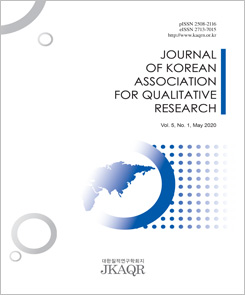
Journal Abbreviation : JKAQR
Frequency : triannual (thrice-yearly)
Doi Prefix : 10.48000/KAQRKR
Year of Launching : 2016
Publisher : Korean Association for Qualitative Research
Indexed/Tracked/Covered By : -
Online Submission
http://submission.kaqrn.or.kr
-
Korean Association
for Qualitative Research -
Editorial Office
Contact Information- Tel: +82-55-772-8234
- E-mail: hchang@gnu.ac.kr -
-
-
-

-

-